

The Vehicle Identification Number (VIN) is the definitive key to your Alfa Romeo. It connects your specific car to its birth certificate, factory build sheet, registration records, and original equipment specifications.
Whether you are verifying a used Giulia, sourcing parts for a Stelvio, or authenticating a classic Spider, the VIN is the starting point for all accurate research.
Key Takeaways:
- A VIN is a unique 17-character code that identifies each Alfa Romeo, mandated by the U.S. National Highway Traffic Safety Administration (NHTSA) starting with the 1981 model year.
- Pre-1980s Alfa Romeo used shorter Chassis Numbers (often called numero di telaio).
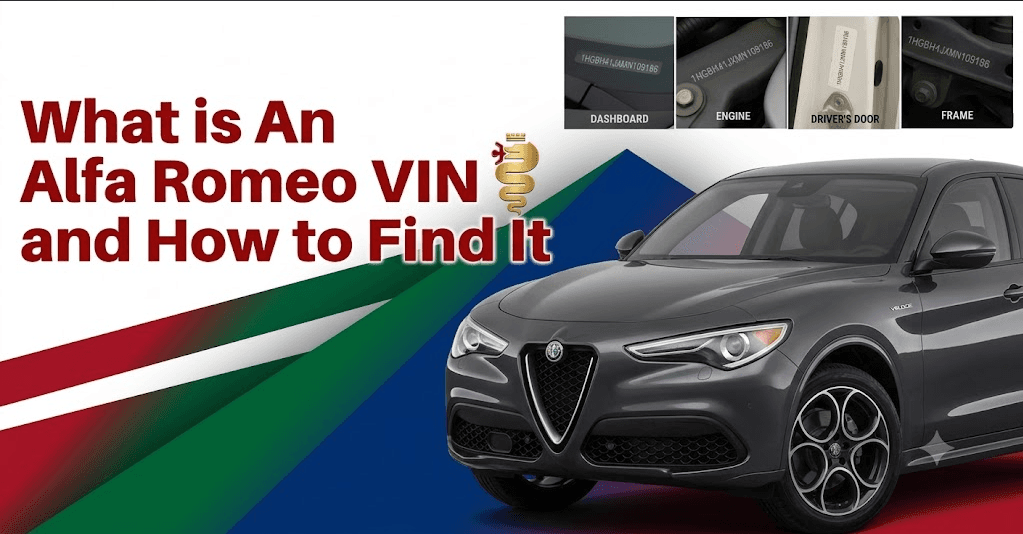
- The VIN is typically found on the driver’s side dashboard (visible through the windshield) and on the driver’s side door jamb.
- The VIN is also listed on all official paperwork, including the title, registration, and insurance documents.
- Using an Alfa Romeo VIN decoder lookup, you can instantly access factory data without needing to memorize the meaning of every character, at no cost. These tools decode all modern Alfa Romeo models and often support classic chassis numbers as well.
What Is an Alfa Romeo VIN?
An Alfa Romeo VIN is a unique, standardized code assigned to every Alfa Romeo as it rolls off the assembly line. This 17-character sequence is the DNA of your vehicle, used for everything from registering the car and securing insurance to investigating a used car's history or ordering the exact right part for a specific trim.
Many people assume all vehicles use the same VIN format. While modern Alfa Romeos use the global 17-character standard, many classic Alfa Romeos (pre-1980s) use shorter, model-specific chassis numbers or serial numbers (often called numero di telaio).
Where to Find the VIN on an Alfa Romeo
Finding the VIN is essential for registration, insurance, and vehicle verification. For most Alfa Romeo cars and SUVs, the VIN is located in standard, easy-to-access locations as you can see on the picture.

These locations are designed to make identification easy for DMV officials, insurance agents, and law enforcement.
For Pre-1981 Classic Alfa Romeos
Classic Alfa Romeos often identify the vehicle using a chassis number stamped directly into the bodywork or on a metal identification plate. Depending on the model, this number may be found:
- On the firewall: Usually on a riveted plate (known as a "data plate") in the engine bay.
- Stamped into the floorpan: On some very early models, the number is stamped under the carpet.
- On the driver's side front suspension tower: A common location for later 105-series cars.
Alfa Romeo assigned chassis prefixes by model family rather than following one universal numbering standard. A Spider, Giulia, Montreal, and Alfetta from the same era often use completely different prefix formats, which is why one decoding chart cannot decode every classic Alfa Romeo.
The Difference Between Modern and Classic Alfa Romeo VINs
Beginning with the 1981 model year, vehicles sold in the United States adopted the standardized 17-character VIN format under federal regulations (ISO 3779). This modern system provides a universal language for identifying every Alfa Romeo, regardless of where it was built.
Unlike modern VINs, classic Alfa Romeo identification numbers were developed independently by the factory and varied significantly by model and era. A 1960s Giulia Sprint GT uses a completely different numbering system than a 1970s Montreal or an Alfetta. As a result, decoding a vintage Alfa often requires model-specific knowledge, though dedicated classic decoders can interpret these older chassis numbers.
How a Modern 17-Character Alfa Romeo VIN Works
All modern Alfa Romeos (sold globally) utilize the standardized 17-character VIN. Each character serves a specific purpose, using numbers (0–9) and letters (A–Z). To avoid confusion, the characters "I," "O," and "Q" are never used. The VIN is divided into three sections:
- World Manufacturer Identifier (WMI): Characters 1–3 identify Alfa Romeo as the manufacturer (typically "ZAR" for cars built in Italy).
- Vehicle Descriptor Section (VDS): Characters 4–9 describe the vehicle's configuration, including the model, engine type, safety system, and the check digit.
- Vehicle Identifier Section (VIS): Characters 10–17 identify the model year, the assembly plant, and the vehicle's unique production sequence.
Example of a 17-Character Alfa Romeo VIN (ZARBAAB48GM183930)
The Alfa Romeo VIN ZARBAAB48GM183930 from a 2016 4C Spider shows how information is distributed throughout the code. See the details below:

| VIN Position | Value | Meaning |
|---|---|---|
| 1 | Z | Country of manufacture: Italy |
| 2 | A | Manufacturer: Alfa Romeo S.p.A. |
| 3 | R | Vehicle type: Passenger Car |
| 4 | B | Model: 4C |
| 5 | A | Body style: Convertible/Cabriolet |
| 6 | A | Engine: 1.75L Turbo Inline-4 |
| 7 | B | Trim: 4C Spider (RWD) |
| 8 | 4 | Safety/Restraint configuration |
| 9 | 8 | VIN check digit |
| 10 | G | Model year: 2016 |
| 11 | M | Assembly plant: Modena, Italy |
| 12-17 | 183930 | Sequential production number |
← Scroll horizontally to see more →
How Pre-1981 Alfa Romeo Chassis Numbers Work
If you've tried looking up the VIN on a classic Alfa Romeo and couldn't find much information, you're not alone. That's because older Alfa Romeos don't use the modern 17-character VIN format found on vehicles built today.
Instead, classic Alfa Romeos use shorter chassis numbers (often called numero di telaio), which follow a completely different identification system that varies in format and length. So, it’s completely normal for pre-1981 Alfa Romeos to have fewer than 17 characters.
A classic Alfa Romeo Spider, Giulia, or GTV from the 1960s or 1970s may have a chassis number that consists of a model prefix followed by a production number (e.g., "AR*123456*").
Example of a Classic Alfa Romeo Chassis Number (AR 3041681)
Although it's much shorter than a modern VIN, it's still the vehicle's official factory identifier. Let's look at what this chassis number tells us.
| Section | Example | What It Means |
|---|---|---|
| Prefix | AR | Alfa Romeo factory chassis prefix |
| Model Series | 304 | Identifies the vehicle's model family |
| Serial Number | 1681 | Individual production number |
← Scroll horizontally to see more →
Unlike a modern VIN, these characters don't directly reveal information such as:
- Engine size
- Trim level
- Body style
- Model year
- Assembly plant
- Factory options
Those details weren't encoded into the chassis number itself.
Note: This is an illustrative example. Classic Alfa Romeo decoding requires specific charts for each model series (105 series, 115 series, etc.). Specialized classic Alfa Romeo VIN decoders are available to help parse these older numbers.
Why Manual Decoding Has Its Limits?
Classic Alfa Romeo chassis numbers can tell you the vehicle family, but they don't contain as much information as today's standardized 17-character VINs.
Even if you find an old chassis number guide, you'll usually only identify the model series; they usually can't confirm the complete identity of a specific vehicle. Important details such as the exact model year, engine configuration, original specifications, and historical records aren't contained in the chassis number alone.
Decode Classic Alfa Romeos Without Manual Research
Manually decoding a classic Alfa Romeo chassis number often requires model-specific production references that vary by generation. Instead of comparing prefixes against historical charts, enter your VIN or chassis number into a specialized Alfa Romeo VIN Decoder to identify both:
- Modern 17-character VINs
- Classic Alfa Romeo chassis numbers (5–14 characters)
Simply enter your VIN or chassis number, and our decoder retrieves the key identity available for that classic Alfa Romeo in seconds. The results of decoding chassis number AR3041681 identify a 1973 Alfa Romeo Spider.

Although the chassis number itself doesn't directly encode every specification, our decoder identifies AR3041681 as a 1973 Alfa Romeo Spider. It displays key information collectors need, such as the engine configuration, transmission, body dimensions, original MSRP, and available historical auction records.
Whether you own a modern Giulia or a classic Spider with a short chassis number, our Alfa Romeo VIN Decoder supports both identification systems. Enter your VIN to instantly verify your vehicle's identity, retrieve factory specifications, and uncover available historical records before buying, restoring, or selling your Alfa Romeo.